One for the Many
September magazine, issue n. 1, 2026
Culture does not so much progress as accumulate. We knew this before the internet, and we knew it in the face of modernism, while waiting for it all to become ‘post-’. When the internet did arrive, one of its unofficial roles was to be the informal archive of the previous centuries, particularly the 20th, leaving us with the option to pick over slowly what had been raced through in the name of progress.
If we are facing the ‘end of history’, as many claim, it’s not because it somehow disappeared. On the contrary; it over-materialised. There is too much of it: the past is way longer and wider than the present. The near-instant availability of so much culture of the recent and distant past – art, photography, music, literature, cinema – is bound to make present creative work fuzzier, less strident, less distinct, more prone to echo, less clear about the future, perhaps. If you are looking at, reading, watching or listening to something now, and it means something to you now, on an important level it is contemporary. We can learn about the past, maybe even learn from it and be inspired by it, but there is no time travel.
My own way of exploring all this has been to spend some of my time in the company of particular images, swapping out the volume of them for the individual pleasures of just a small handful. I have written long essays focused on single images, and even written a few whole books about others. I have made exhibitions about single images, too. In the spirit of this, I want to recount here my experience with just one of them.
Predicting the future doesn’t interest me, although the passage of photographs through time does. In fact, I think it’s the only way to even begin to understand them. When asked what makes a great photograph, Walker Evans once replied, only slightly ironically, “About thirty years.” Most photographs do not last even that long, but some do, either by accident, neglect, or intention. I guess what Evans really meant by ‘time’ is change. Cultural change. Political change, perhaps. Change in the look of things and in what we might consider significant. In this sense, we can think of photographs not as ‘having’ meanings but as giving rise to unexpected meanings, unexpected responses. Photographs have biographies, the way people have biographies, and they are just as full of accident, neglect and intention.
Quite by chance, I came across this photograph on eBay, while looking for something else. This was a little over a decade ago. Several major American newspapers were selling off their archives of press prints, hoping to raise money to keep themselves afloat in the digital era. Hundreds of thousands of them were available, and most still are.
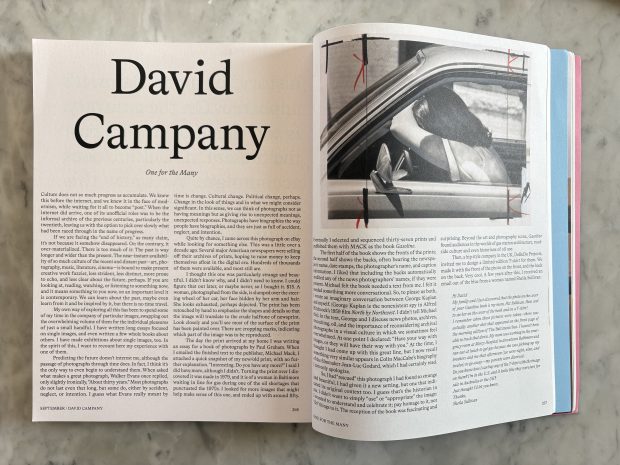
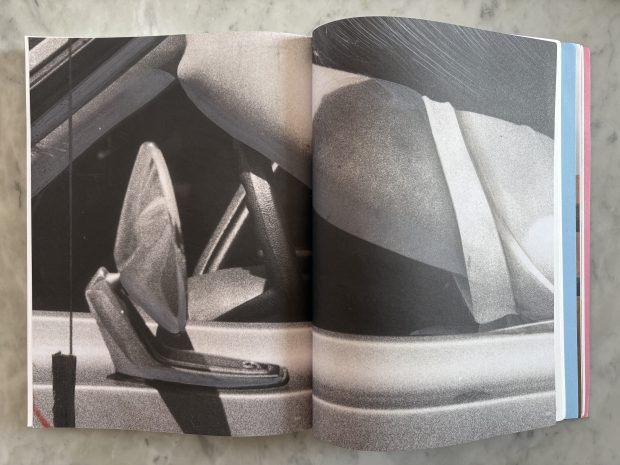
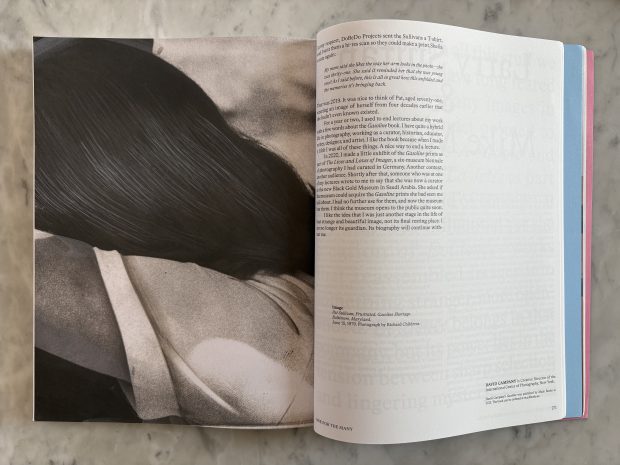
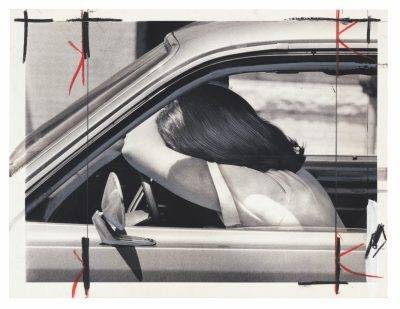
I thought this one was particularly strange and beautiful. I didn’t know why, and I didn’t need to know. I could figure that out later, or maybe never, so I bought it. $15. A woman, photographed from the side, is slumped over the steering wheel of her car, her face hidden by her arm and hair. She looks exhausted, perhaps dejected. The print has been retouched by hand to emphasise the shapes and details so that the image will translate to the crude halftone of newsprint. Look closely and you’ll see most of the surface has been painted over. There are cropping marks, indicating which part of the image was to be reproduced.
The day the print arrived at my home I was writing an essay for a book of photographs by Paul Graham. When I emailed the finished text to the publisher, Michael Mack, I attached a quick snapshot of my new/old print, with no further explanation. “Interesting. Do you have any more?” I said I did have more, although I didn’t. Turning the print over I discovered it was made in 1979, and it is of a woman in Baltimore waiting in line for gas during one of the oil shortages that punctuated the 1970s. I looked for more images that might help make sense of this one, and ended up with around fifty. Eventually I selected and sequenced thirty-seven prints and published them with MACK as the book Gasoline.
The first half of the book shows the fronts of the prints; the second half shows the backs, often bearing the newspaper’s name, date stamps, the photographer’s name, and caption information. I liked that including the backs automatically credited any of the news photographers whose names if they were present. Michael felt the book needed a text by me. I felt it needed something more conversational. So, to please us both I wrote an imaginary conversation between George Kaplan and myself. (George Kaplan is the non-existent spy in Alfred Hitchcock’s film North by Northwest 1959. I didn’t tell Michael this). In the text, George and I discuss news photos, archives, retouching, oil, and the importance of reconsidering archival photographs in a visual culture in which we sometimes feel overwhelmed. At one point I declared: “Have your way with images, or they will have their way with you.” At the time, I thought I had come up with this great line, but I now recall something very similar appears in Colin MacCabe’s biography of the filmmaker Jean-Luc Godard, which I had certainly read. I can only apologise.
So, I had ‘rescued’ this photograph I had found so strange and beautiful. I had given it a new setting, but one that indicated its original context too. I guess that’s the historian in me. I didn’t want to simply ‘use’ or ‘appropriate’ the image: I wanted to understand and celebrate it; pay homage to it, not ‘do’ things to it. The reception of the book was fascinating and surprising. Beyond the art and photography scene, Gasoline found audiences in the worlds of gas station architecture, roadside culture and even historians of oil use.
Then, a hip style company in the UK, DoBeDo Projects, invited me to design a limited-edition t-shirt for them. We made it with the front of the photo on the front, and the back on the back. Very cool. A few years after this, I received an email out of the blue from a woman named Sheila Sullivan:
Hi David
My family and I just discovered that the photo on the cover of your Gasoline book is my mom, Pat Sullivan. How cool to see her on the cover of the book and on a t-shirt!
I remember when those pictures were taken – there was actually another shot that appeared on the front page of the morning edition of The Baltimore Sun. I haven’t been able to track that down. My mom was working in the emergency room at Mercy Hospital in downtown Baltimore and ran out at lunch to get gas because she was picking up my brothers and me that afternoon (we were 8,9 and 12) to go away – my parents were divorced.
Do you know how I can buy any of the t-shirts with the image on them? I’m in the US and it looks like they were/are for sale in Australia or the UK?
Just thought I’d let you know.
Thanks,
Sheila Sullivan
At my request, DoBeDo Projects sent the Sullivans a t-shirt, and I sent them a hi-res scan so they could make a print. Sheila wrote again:
My mom said she likes the way her arm looks in the photo – she was 31. She said it reminded her that she was young once! As I said before, this is all so great how this unfolded and the memories it’s bringing back.
That was 2019. It was nice to think of Pat, aged 71, wearing an image of herself from four decades earlier that she hadn’t even known existed.
For a year or two, I used to end lectures about my work with a few words about the Gasoline book. I have quite a hybrid life in photography, working as a curator, historian, educator, writer, designer and artist. I like the book because when I made it, I felt I was all of these things. A nice way to end a lecture.
In 2020 I made a little exhibit of the Gasoline prints as part of The Lives and Loves of Images, a six-museum biennale of photography I had curated in Germany. Another context, another audience. Shortly after that, someone who was at one of my lectures wrote to me to say that she was now a curator at the new Black Gold Museum in Saudi Arabia. She asked if the museum could acquire the Gasoline prints that she had seen me talk about. I had no further use for them, and now the museum has them. I think the museum opens to the public quite soon.
I like the idea that I was just another stage in the life of that strange and beautiful image, not its final resting place. I am no longer its guardian. Its biography will continue without me.
David Campany
Many thanks to Rain Chan, Andrea Orejarena, and Caleb Stein, editors of September.