Eugène Atget: the Making of a Reputation
International Center of Photography, Jan 29 - May 4, 2026
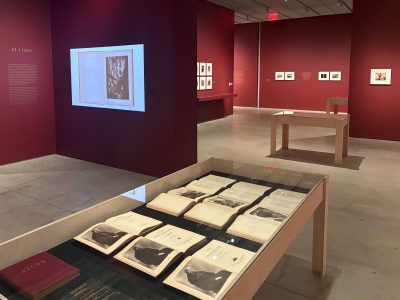
Eugène Atget: The Making of a Reputation, examines how Eugène Atget (1857–1927) came to be regarded as one of the forefathers of modern photography through the timely and tireless advocacy of Berenice Abbott. Featuring historic prints from ICP’s collection alongside landmark publications and other printed ephemera, the exhibition reconsiders the role that Abbott played in establishing Atget’s now-canonical status, sometimes to the detriment of her own remarkable career as a photographer. Though Atget didn’t live to see it, Abbott became the ideal steward, proving that every photographer needs a champion.
Over the last three decades of his life, Atget undertook an intensive documentation of Paris and its surrounding districts, assembling a vast archive of a time and place under acute pressure from the forces of 20th century modernization. Major monuments and humble buildings; storefronts, staircases, ironwork and street traders; parks, trees and the undefined edges of the city—all were among the litany of subjects he photographed, both preserving and transfiguring their inherent formal and historical qualities.
In 1923, Bernice Abbott, then a young sculptor, was introduced to the artist Man Ray and became his studio assistant. She soon took to photography and met Atget—whose studio was on the same street as Man Ray’s—in 1926. The following year, she made three portraits of Atget, but he died shortly before she could show them to him. Though a portion of Atget’s prints were sold to the city archives of Paris, Abbott managed to acquire what remained and then, with little prospect of financial gain, immediately began promoting his work, convinced it was a major artistic achievement. Decades later, in 1968, her role as Atget’s champion would come to its natural close, as the 1,415 glass negatives and around 8,000 vintage prints in her collection were acquired by the Museum of Modern Art, New York, which took up the task of advocating for Atget and his work.
Curated by David Campany, Creative Director at ICP, Eugène Atget: The Making of a Reputation focuses on the years between the publication of Atget’s images (uncredited) in the journal La Révolution Surréaliste in 1926 and the appearance four years later of ATGET: Photographe de Paris, the first book of his work, overseen by Abbott. It presents three related expressions of Atget’s work: the magazines that published it, the prints (drawn primarily from ICP’s collection) and the images chosen for the book. Each provides distinct insights into how the meaning and significance of his photographs was formed, claimed and positioned.
“Every photographer needs a champion,” said Campany. “Eugène Atget had Berenice Abbott and without her, his work would have been all but lost.”
The exhibition, curated by David Campany, does not pretend to be comprehensive. What it offers is an argument. This is a show less about Atget than about what happened to him after he died: how an elderly commercial photographer who advertised his services with a door sign reading “Documents pour artistes” and sold prints to decorators, architects, and antiquarians came to be regarded as one of the founders of modern photography. That transformation was largely the work of one woman, and the story of her 40-year campaign is as remarkable as the photographs themselves.
Berenice Abbott first encountered Atget’s photographs in 1925, while working as Man Ray’s darkroom assistant a few doors down the same street. Man Ray had hung Atget prints on his studio walls; he offered to lend the old man a modern handheld camera, which Atget refused on the grounds that such cameras worked faster than he could think. When Abbott saw the prints, she experienced what she later called a sudden flash of recognition—the shock, she said, of realism unadorned. The “subjects were not sensational, but nevertheless shocking in their very familiarity,” she wrote. She began visiting Atget’s studio, looking through his albums, buying prints when she could afford the five or 10 francs he charged. She called him a “Balzac of the camera” and encouraged Jean Cocteau, Robert McAlmon, and James Joyce to buy from him. The surrealists took notice. In 1926, four of Atget’s photographs appeared in La Révolution surréaliste, uncredited at his own insistence. “Don’t put my name on it,” he told Man Ray. “These are simply documents I make.” The surrealists saw urban dreamlife and involuntary poetry. Abbott saw something else entirely.
——
“In the spring of 1927, Abbott photographed Atget—three exposures: standing, frontal, profile—the only formal portraits of him known to exist. In them, he looks ancient and depleted, his shoulders slumped. As Julia Van Haaften recounts in her biography Berenice Abbott: A Life in Photography (2018), Atget had dressed up for the sitting in “a suit and handsome overcoat,” but no costume could disguise the body’s testimony. Months later, she climbed the stairs to deliver the proofs. The familiar studio door sign was gone. She “thought she had climbed too high.” She went back down, found the concierge, and asked:
“Where is M. Atget?”
“M. Atget is dead.”
Campany, who has written more eruditely than almost anyone about the space between the photographic document and the work of art, has painted the walls of the galleries at the ICP red, the exhibition text gilded onto them like the foil-stamped spine of a scholarly monograph. Beneath the small, framed albumen prints run custom-built vitrines housing newspaper clippings, magazine pages, books—the paper trail of a 40-year campaign. Full-size reproductions of book pages are pasted directly onto the walls between the prints: Abbott’s 1929 essay for Creative Art, one by Walker Evans in Hound & Horn, a Le Crapouillot special issue on Paris. An Associated Press wire. Some of Atget’s prints are installed overlapping with the published material, photographs and magazine pages physically interleaved. It is not the most comprehensive exhibition of Atget’s work, nor are these necessarily his finest prints. But it is astutely curated. You cannot look at the photographs without also looking at what was done to bring them to you”
Tobias Czudej, ‘Being Eugène Atget’, LA Review of Books, May 8, 2026