Fotografia e cinema, diversi ma connessi
IL GIORNALE DELL'ARTE, May 15, 2025
Fotografia e cinema, diversi ma connessi
Lo scrittore e curatore David Campanyriflette sulla permeabilità tra i due linguaggi dalle origini all’Intelligenza Artificiale
David Campany, creative director dell’International Center of Photography di New York, scrittore e curatore, è una delle voci più acute nella riflessione sul rapporto tra fotografia e cinema. Ha esplorato questa relazione in alcuni libri fondamentali, tra cui On Photographs (2020) e Photography and Cinema (2008), e soprattutto in The Cinematic (2007), antologia che raccoglie numerosi testi chiave sulla dialettica tra immagine fissa e immagine in movimento.
Nell’intervista che segue, Campany riflette sulla crescente permeabilità tra i due linguaggi: dall’estetica cinematografica nella fotografia contemporanea alle nuove intersezioni rese possibili dal digitale, per poi interrogarsi sulla persistenza della fotografia in quanto arte della staticità in un’epoca dominata dal flusso visivo.
Negli ultimi anni, il legame tra cinema e fotografia si è rafforzato, come provano la recente mostra di Wim Wenders a New York, il coinvolgimento di Jim Jarmusch a Paris Photo e i libri fotografici di Yorgos Lanthimos per Mack. Cosa rivelano questi progetti sull’evoluzione del rapporto tra i registi e l’immagine fissa?
Già i Lumière, con il loro background, integravano la fotografia nei film. Negli anni Venti, la mostra «Film und Foto» approfondì questo legame, avvicinando la fotografia al cinema anziché alla pittura. Esistono poi forme ibride, come il racconto fotografico e il foto-saggio, e molti registi hanno radici lì, nella fotografia: Stanley Kubrick iniziò come fotografo, mentre Helmar Lerski compì il percorso inverso. Anche Wenders, nei suoi primi film, spesso ritraeva personaggi intenti a scattare foto e si ispirava all’immagine fissa. Forse oggi viviamo un rinnovato interesse per il rapporto tra fotografia e cinema, anche se il dialogo è sempre stato vivo: chiunque può scattare foto e girare video, rendendo questa connessione ancora più evidente.
Questo rapporto è diventato più simbiotico o competitivo?
Entrambi. I fotografi spesso riflettono sul cinema, il che li porta a interrogarsi su ciò che la fotografia può fare e il cinema no. Allo stesso modo, i registi ispirati dalla fotografia la apprezzano profondamente, pur sapendo che il loro linguaggio è molto diverso, benché connesso. Nell’arte esiste sempre una tensione tra il simbiotico e il competitivo. Essere in competizione con qualcosa significa avere un legame forte con essa. La fotografia può scegliere se confrontarsi con il cinema, con la pittura, con la scultura… o con niente.
Crede che la fotografia contemporanea stia diventando sempre più «cinematica»?
La fotografia, nella sua essenza, si basa sulla staticità. Tuttavia, ogni foto ha un rapporto unico con tempo e spazio. Pochi fotografi cercano immagini completamente singole: la maggior parte lavora su serie o sequenze, come se una sola non bastasse. Jeff Wall è uno dei rari autori a concentrarsi su questo. Benché sia accostato al cinema, il suo interesse sta nell’immagine silenziosa e singolare. Si parla spesso di fotografi come «visual storytellers», e sebbene la fotografia possa raccontare storie, farlo con una sola immagine è complesso senza il supporto del linguaggio scritto o parlato. Per questo molti superano i limiti della fotografia aggiungendo altre immagini o testi, avvicinandosi talvolta al cinema.
Artisti come Gregory Crewdson e Cindy Sherman creano immagini costruite con un’estetica cinematografica. Questo snatura la fotografia?
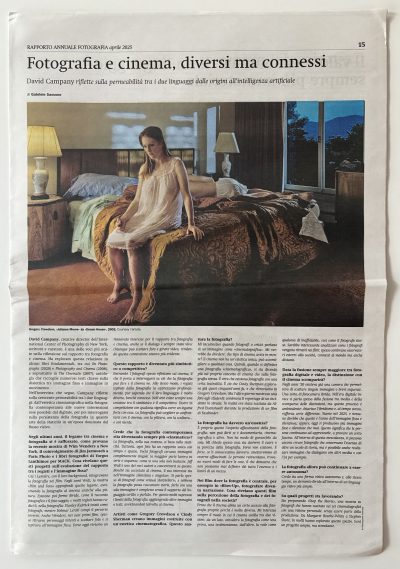
Mi incuriosisce quando fotografi o critici parlano di un’immagine come «cinematografica». Mi verrebbe da chiedere: che tipo di cinema avete in mente? Il cinema non ha un’estetica unica, può assomigliare a qualsiasi cosa. Quindi, quando si definisce una fotografia «cinematografica», si sta dicendo più sul proprio concetto di cinema che sulla fotografia stessa. È vero che esistono fotografie con una certa teatralità. È ciò che Cindy Sherman esplorava già quasi cinquant’anni fa, e che ritroviamo in Gregory Crewdson. Ma l’altro giorno mostravo una foto agli studenti: sembrava il reportage di un incidente in strada. In realtà era stata scattata da Alfred Eisenstaedt durante la produzione di un film di Fassbinder.
La fotografia ha davvero un’essenza?
È proprio questo l’aspetto affascinante della fotografia: non può dirti se è documentaria, cinematografica o altro. Non ha modo di garantirlo da sola. Mi chiedo spesso cosa sia davvero il cuore o la purezza della fotografia. Forse non esistono. E forse, se li conoscessimo davvero, smetteremmo di esserne affascinati. Le persone reinventano, trovano nuovi modi di fare le cose, il che dimostra che non possiamo mai definire del tutto l’essenza o i limiti di un mezzo.
Nei film dove la fotografia è centrale, per esempio in «Blow-Up», fotografare diventa narrazione. Cosa rivelano questi film sulla percezione della fotografia e dei fotografi nella società?
Penso che il cinema abbia un certo accesso alla fotografia proprio perché è molto diversa. Mi interessa sempre il modo in cui il cinema oscilla tra due visioni: da un lato, considera la fotografia come una prova, una testimonianza; dall’altro, la vede come qualcosa di inaffidabile, così come il fotografo stesso. Sarebbe interessante analizzare come i fotografi vengono ritratti nei film: spesso sembrano osservatori esterni alla società, connessi al mondo ma anche distanti.
Data la fusione sempre maggiore tra fotografia digitale e video, la distinzione con il cinema scomparirà?
Negli anni ’20 esisteva già una camera che permetteva di scattare singole immagini o brevi sequenze. Una sorta di fotocamera ibrida. Nell’era digitale invece si parla spesso della fusione tra media e della scomparsa delle distinzioni, ma questo processo è ambivalente: chiarisce l’ibridismo e, al tempo stesso, rafforza certe differenze. Siamo nel 2025, e nessuno direbbe che questo è l’anno dell’immagine fissa e silenziosa; eppure, oggi si producono più immagini fisse e silenziose che mai. Questo significa che le persone continuano ad apprezzarle, a provare un certo fascino. All’interno di questa mescolanza, si possono ancora creare fotografie che conservano l’essenza di oltre un secolo di storia, ma è possibile anche realizzare immagini che dialogano con altri media o con l’IA per esempio.
La fotografia allora può continuare a essere autonoma?
Credo sia una forma visiva autonoma e, allo stesso tempo, un elemento ibrido all’interno di un linguaggio visivo più ampio.
Su quali progetti sta lavorando?
Sto preparando «Stop the Movie», una mostra su fotografi che hanno scattato sui set cinematografici con una visione personale, senza essere parte della produzione. Da Margaret Bourke-White a Stephen Shore, in molti hanno esplorato questo spazio. Sarà un progetto ampio, ma stimolante.
English version:
In recent years, the link between cinema and photography has strengthened, as evidenced by Wim Wenders‘ recent exhibition in New York, Jim Jarmusch’s involvement in Paris Photo and Yorgos Lanthimos’ photo books for MACK. What do these projects reveal about the evolution of the relationship between filmmakers and the still image?
Already the Lumières, with their background, were integrating photography into films. In the 1920s, the ‘Film und Foto’ exhibition deepened this link, bringing photography closer to film than painting. There are also hybrid forms, such as the photo-narrative and the photo-essay, and many filmmakers have their roots there, in photography: Stanley Kubrick began as a photographer, while Helmar Lerski took the reverse route. Even Wenders, in his early films, often portrayed characters taking pictures and was inspired by the still image.
Perhaps today we are experiencing a renewed interest in the relationship between photography and film, although the dialogue has always been alive: anyone can take photos and shoot videos, making this connection even more evident.
Has this relationship become more symbiotic or competitive?
Both. Photographers often reflect on cinema, which leads them to question what photography can do and cinema cannot. Similarly, filmmakers inspired by photography deeply appreciate it, even though they know that their language is very different, albeit connected.
In art, there is always a tension between the symbiotic and the competitive. To be in competition with something is to have a strong bond with it. Photography can choose to compete with cinema, with painting, with sculpture… or with nothing.
Do you believe that contemporary photography is becoming increasingly ‘cinematic’?
Photography, in its essence, is based on staticity. However, each photo has a unique relationship with time and space. Few photographers look for completely single images: most work in series or sequences, as if one was not enough.
Jeff Wall is one of the rare authors to focus on this. Although he is compared to film, his interest lies in the silent, singular image.
Photographers are often referred to as ‘visual storytellers’, and although photography can tell stories, doing so with a single image is complex without the support of written or spoken language. This is why many overcome the limits of photography by adding other images or texts, sometimes approaching cinema.
Artists like Gregory Crewdson and Cindy Sherman create images constructed with a cinematic aesthetic. Does this distort photography?
I am intrigued when photographers or critics refer to an image as ‘cinematic’. I would like to ask: what kind of cinema do you have in mind? Cinema does not have a unique aesthetic, it can look like anything. So when you call a photograph ‘cinematic’, you are saying more about your concept of cinema than about the photograph itself.
It is true that there are photographs with a certain theatricality. This is what Cindy Sherman explored almost fifty years ago, and what we find in Gregory Crewdson. But the other day I was showing a photo to students: it looked like a report of an accident on the street. In reality it had been taken by Alfred Eisenstaedt during the production of a Fassbinder film.
Does photography really have an essence?
That is the fascinating thing about photography: it cannot tell you whether it is documentary, cinematographic or something else. It has no way of guaranteeing this on its own. I often wonder what the heart or purity of photography really is. Maybe they don’t exist. And maybe if we really knew them, we would stop being fascinated by them. People reinvent, find new ways of doing things, which shows that we can never fully define the essence or limits of a medium.
In films where photography is central, for example in Blow-Up, photography becomes narrative. What do these films reveal about the perception of photography and photographers in society?
I think cinema has a certain access to photography precisely because it is very different. I am always interested in how cinema oscillates between two visions: on the one hand, it sees photography as evidence, as testimony; on the other hand, it sees it as something unreliable, as does the photographer himself. It would be interesting to analyse how photographers are portrayed in films: they often seem to be observers from outside society, connected to the world but also distant.
Given the increasing fusion of digital photography and video, will the distinction with cinema disappear?
In the 1920s, there was already a camera that could take single images or short sequences. A kind of hybrid camera.
In the digital era, on the other hand, we often talk about the fusion of media and the disappearance of distinctions, but this process is ambivalent: it clarifies hybridity and, at the same time, reinforces certain differences. It is 2025, and no one would say that this is the year of the still and silent image; yet more still and silent images are being produced today than ever before. This means that people continue to enjoy them, to feel a certain fascination.
Within this mixture, one can still create photographs that retain the essence of more than a century of history, but one can also make images that dialogue with other media or with AI for example.
Can photography then continue to be autonomous?
I believe it is an autonomous visual form and, at the same time, a hybrid element within a broader visual language.
What projects are you working on? Can you give us some hints about the big Jeff Wall exhibition that you will curate at Gallerie d’Italia – Turin in 2025?
I am preparing ‘Stop the Movie’, an exhibition about photographers who shot on film sets with a personal vision, without being part of the production. From Margaret Bourke-White to Stephen Shore, many have explored this space. It will be a wide-ranging but challenging project.
With Jeff Wall, on the other hand, I have often collaborated, but never in a project dedicated only to him. The exhibition in Turin will include diptychs and triptychs, many interesting visual connections. Jeff is unique in photography: his work is unlike any other.